
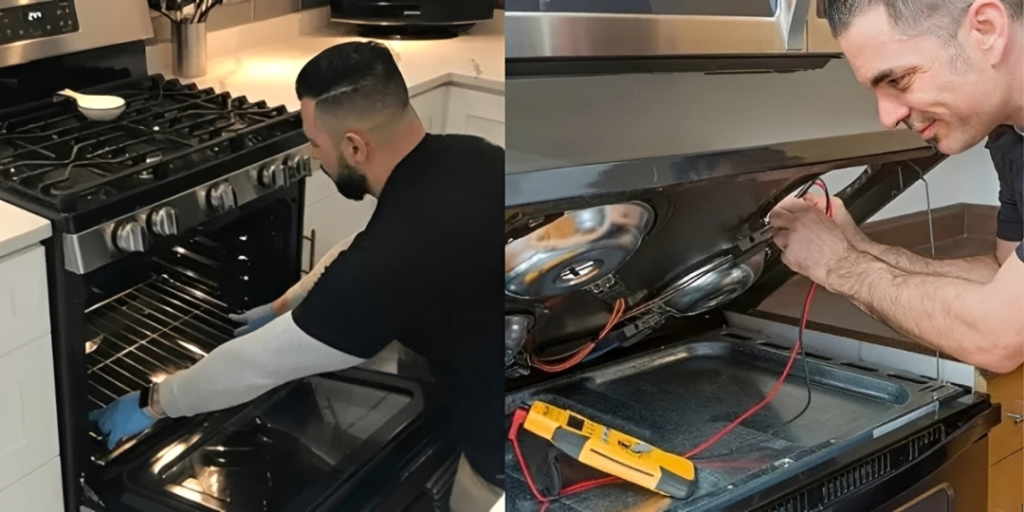
People often assume that fixing a range is the same job regardless of whether it runs on gas or electric. It’s not. The two run on completely different systems, which means they fail differently, get diagnosed differently, and in the case of gas, come with a safety layer electric doesn’t need to worry about.
How a Gas Range Actually Works
A gas range relies on a burner, an igniter, and a gas valve working together. Modern ranges use electronic ignition instead of a standing pilot light, so when a burner won’t light, the most common causes are a failed igniter, a burner port clogged with food debris, or occasionally a gas valve that isn’t opening the way it should. The flame color itself is a real diagnostic signal here, a healthy burner flame should be blue, a yellow or orange flame points to a combustion problem worth addressing, not just a cosmetic thing.
How an Electric Range Actually Works
Electric ranges skip gas and ignition entirely. Older models use coil elements that heat directly, newer smooth-top models use radiant or induction elements under a glass surface. When an electric burner won’t heat, it’s usually the element itself, the internal switch controlling it, or in some cases the control board managing power to that specific burner. There’s no flame to read here, the troubleshooting is entirely electrical.
Where the Oven Itself Is More Similar Than You’d Think
Whether the cooktop is gas or electric, most ovens use similar components for actual baking, a bake element or gas burner at the bottom, a broil element or burner at the top, and a thermostat or sensor managing temperature. An oven that won’t hold temperature, runs hot or cold, or doesn’t heat evenly is often a thermostat, sensor, or heating element issue on either fuel type, that part of the diagnosis doesn’t change much between gas and electric.
The One Real Safety Difference
This is the part that matters most. A gas range involves an actual gas line, and a smell of gas, whether the burner is on or off, is not something to wait on. Relighting a burner once or twice following the manual is fine. If it won’t light after that, or you smell gas at any point, that’s the moment to stop and call someone rather than keep trying. Electric ranges don’t carry that same risk, a failed element is an inconvenience, not a safety issue.
Common Problems by Type
- Gas: burner won’t light, igniter clicks but nothing catches, yellow or uneven flame, burner port clogged
- Electric: element won’t heat, element glows but food doesn’t cook evenly, control board not responding to a specific burner
- Both: oven won’t hold temperature, uneven baking, self-clean cycle not completing, door not sealing properly
Does One Type Last Longer Than the Other?
Not meaningfully. Both gas and electric ranges typically run 13 to 15 years or more with reasonable care, since either type has relatively few moving parts compared to something like a washer or dryer. The deciding factor in a repair-or-replace decision is usually the specific part that’s failed and how many other issues the unit has had, not which fuel type it runs on.
What About Induction Ranges?
Induction is a newer category that’s technically electric, but it heats differently than a traditional coil or radiant element, using magnetic fields to heat the pan directly rather than heating the cooktop surface itself. When an induction burner fails, it’s usually the induction coil or the control board managing it, not something a homeowner typically diagnoses on their own. If you have one of these and it’s not heating right, that’s worth a repair call rather than trial and error, the components involved are more specialized than a standard electric range.
A Simple Way to Tell Which Type of Problem You Have
If you smell gas, hear a clicking igniter, or see a flame at all, you’re troubleshooting a gas system. If the burner is silent and either glows or doesn’t, you’re troubleshooting an electrical one. That distinction alone usually points a technician toward the right starting point before ever removing a panel.
What You Can Safely Check Yourself
On a gas range, confirming the burner cap is seated correctly and the port isn’t visibly clogged with debris is a reasonable first check. On an electric range with removable coil elements, swapping a suspect element with a working one from another burner position can help confirm whether the element itself or the switch behind it is the problem. Beyond that, both types involve either gas lines or line voltage electrical connections, not something to open up further without the right experience.
Frequently Asked Questions (FAQS)
My gas burner clicks but won’t light, what’s wrong?
That’s almost always the igniter itself or a clogged burner port, not the whole range failing. It’s a common, straightforward repair.
My electric burner glows but food cooks unevenly, is that normal?
Not necessarily. That can point to a warped element or an uneven power delivery issue. Worth having it checked rather than just working around it.
Is it more expensive to repair a gas range than an electric one?
It depends entirely on the specific part that’s failed, not the fuel type. Simple igniter or element replacements are similarly priced either way.
Do you work on both gas and electric ranges?
Yes, both. The diagnosis process is different, but I handle range and oven repair for either type.
Do you work on induction ranges too?
Yes. Induction is technically electric, and it’s part of the range and oven repair I handle, though it uses different components than a standard coil or radiant electric range.
Should I switch from gas to electric, or electric to gas, when it’s time to replace?
That’s more of a kitchen preference and cost question than a repair one, gas ranges are generally favored for more responsive heat control, electric and induction for cleaner cooktops and more even oven baking. Either fuel type is reliable when properly maintained, this isn’t a decision I’d make for you, but I’m happy to talk through what you’re used to and what might fit your kitchen better.
Range or oven acting up, gas or electric? Book a time here and I’ll get it diagnosed and fixed right.